Bruno Marques
Bruno Marques
Home
Projects
Publications
Teaching
Contact
Light
Dark
Automatic
2
Spatially and color consistent environment lighting estimation using deep neural networks for mixed reality
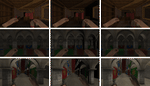
This paper presents a CNN-based model to estimate complex lighting for mixed reality environments with no previous information about the scene. We model the environment illumination using a set of spherical harmonics (SH) environment lighting, capable of efficiently represent area lighting. We propose a new CNN architecture that inputs an RGB image and recognizes, in real-time, the environment lighting. Unlike previous CNN-based lighting estimation methods, we propose using a highly optimized deep neural network architecture, with a reduced number of parameters, that can learn high complex lighting scenarios from real-world high-dynamic-range (HDR) environment images.
Bruno A D Marques
,
Esteban Clua
,
Anselmo Montenegro
,
Cristina Nader
PDF
Cite
Project
DOI
Machine learning recognition of light orbital-angular-momentum superpositions
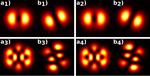
We develop a method to characterize arbitrary superpositions of light orbital angular momentum (OAM) with high fidelity by using astigmatic transformation and machine-learning processing. In order to identify each superposition unequivocally, we combine two intensity measurements. The first one is the direct image of the input beam, which is invariant for positive and negative OAM components. The second one is an image obtained using an astigmatic transformation, which allows distinguishing between positive and negative topological charges. Samples of these image pairs are used to train a convolution neural network and achieve high-fidelity recognition of arbitrary OAM superpositions.
Braian Pinheiro da Silva
,
Bruno A D Marques
,
Rafael Bellas Rodrigues
,
Paulo Henrique Souto Ribeiro
,
Antonio Zelaquett Khoury
PDF
Cite
Project
DOI
Machine and Deep Learning Applied to Galaxy Morphology - A Comparative Study
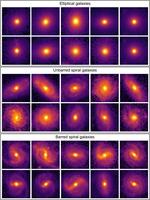
we investigate how to substantially improve the galaxy classification within large datasets by mimicking human classification. We combine accurate visual classifications from the Galaxy Zoo project with machine and deep learning methodologies. We propose two distinct approaches for galaxy morphology, one based on non-parametric morphology and traditional machine learning algorithms; and another based on Deep Learning.
Paulo Barchi
,
Reinaldo Carvalho
,
Reinaldo Rosa
,
Rubens Sautter
,
Michelle Santos
,
Bruno A D Marques
,
Esteban Clua
,
Camila Freitas
,
Tatiana Moura
PDF
Cite
Project
DOI
Deep spherical harmonics light probe estimator for mixed reality games
We present the Spherical Harmonics Light Probe Estimator, a deep learning based technique that estimates the lighting setting of the real-world environment. The method uses a single RGB image and does not requires prior knowledge of the scene. The estimator outputs a light probe of the real-world lighting, represented by 9 spherical harmonics coefficients. The estimated light probe is used to create a composite image containing both real and virtual elements in an environment with a consistent illumination.
Bruno A D Marques
,
Esteban Clua
,
Cristina Nader
PDF
Cite
Project
DOI
Cite
×